Recently we were in Georgia for the introductory film and the VR film for our museum. A look behind the scenes. Part 4: tears and shoe size 48.
When the camera crew has put their suitcases in the car and waves goodbye as they drive away, the owner of the bed and breakfast in Ateni asks what kind of film we are actually making. Surely not about the village of Ateni, she asks in surprise.
I briefly tell Zia the story. We are making a film about a soldier who went missing during World War II. He was one of 865 war victims from the Soviet Union who ended up in a cemetery in the Netherlands. One of those soldiers, I tell her, is from here. And his family member helped us find a suitable film location: Soso Vanishvili, maybe you know him?
Zia freezes, her kind face suddenly tense and tears well up in her eyes. “Vanishvili? Was the soldier’s name Vanishvili? Iosif Vanishvili?”
It turns out that Zia’s mother’s name is Vanishvili. And her brother left for the front and never came home. “My mother waited her whole life for her brother and my grandmother, who lived to be 86, read tarot cards every day to see if her son would come back.”
I explain that the soldier in the Netherlands had a different first name. But Zia does not want to let go of the suddenly rediscovered hope of finding news about her mother’s brother, the uncle she never got to know.
“Georgians are small, but Iosif was almost two meters tall and had shoe size 48. Grandma was proud that she had brought such a big guy into the world. We have always kept his boots, so-called Asian boots, size 48. Did the soldier who is buried in the Netherlands perhaps have very big feet?”
Zia doesn’t seem to hear me when I say that her uncle Iosif is not the soldier who is in the Netherlands. “He was 18 when he left for the front. We never heard from him again, although someone said that he had been taken prisoner of war and that he had seen him in France.”
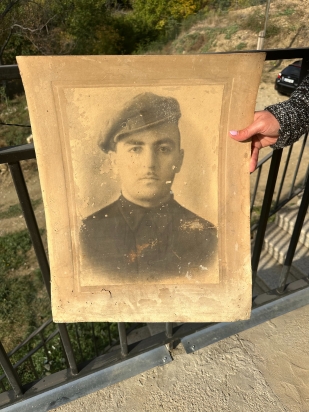
France, I think, that’s where the battalion with Georgians was that later ended up on Texel via Zandvoort. Zia wanders away and soon returns with a photo of Iosif, who has never been out of the thoughts of his family. “Is this the soldier in the Netherlands?”
I explain that there were no photos of the soldiers at the war cemetery and that Iosif is definitely not in Leusden.
Zia is disappointed. I search online databases to see if I can find more about her Iosif. I find him as ‘missing in action’. The first name, father’s name, last name and year of birth match what Zia gave me. The region where he lived is also correct, only Ateni is not listed as the village but ‘Chechlan-Ubani’. ‘Yes!’ says Zia. She points to a hill across from her bed and breakfast. ‘That is Chechlan-Ubani, a hamlet that belongs to Ateni. That is where they lived, here they worked.’
The discovery of Iosif in online databases unfortunately does not change his status: he remains missing in action. But Zia does not let go. “Please look for him? In France too?”
I promise to publish about him and I call the camera crew, who are almost back in Tbilisi by now. The crew reacts with surprise. What a coincidence! “Well, coincidence? Almost every family in the former Soviet Union lives with an open wound, with a family member who has gone missing.”